
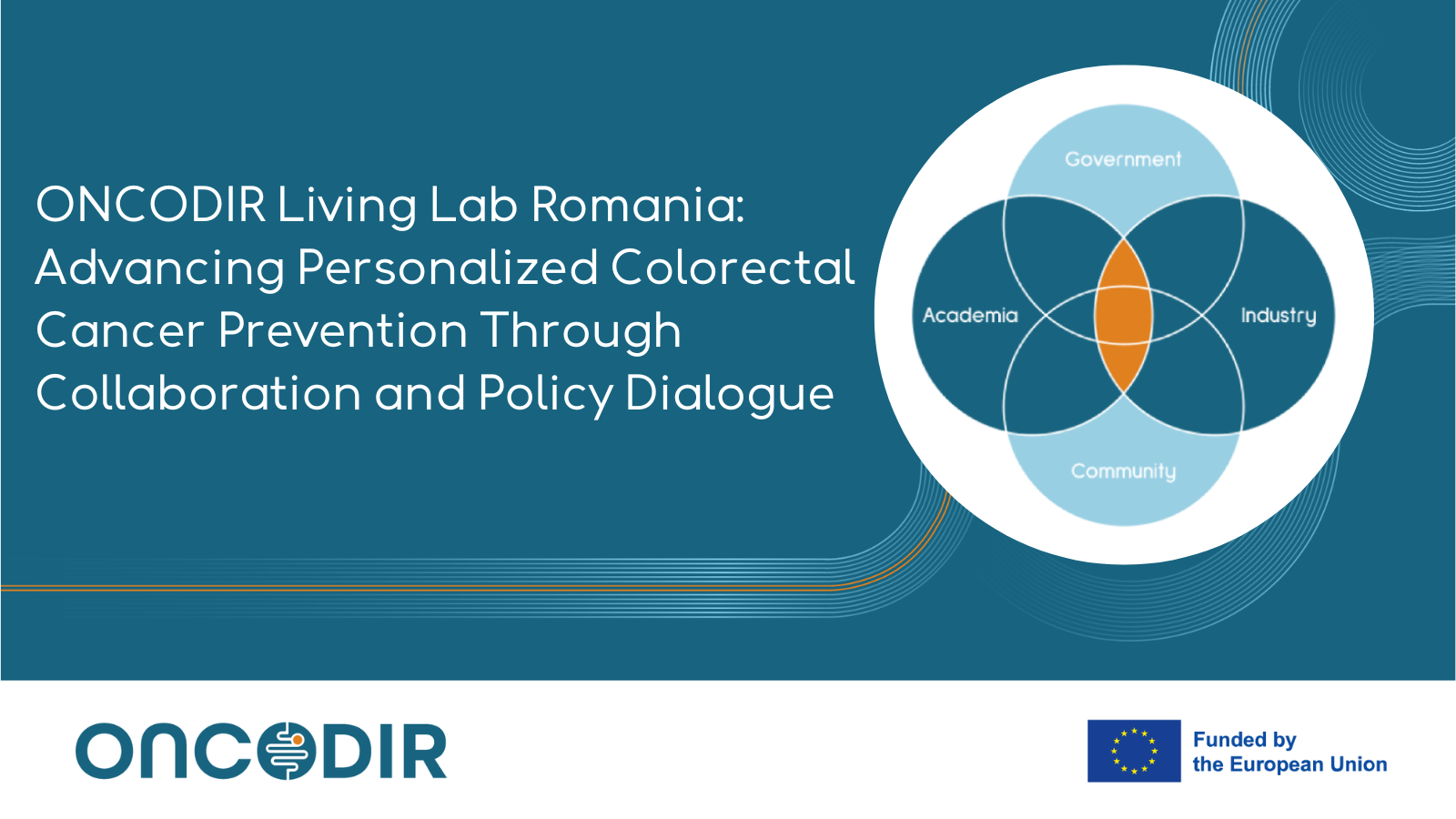
ONCODIR Living Lab Romania: Advancing Personalized Colorectal Cancer Prevention Through Collaboration and Policy Dialogue
The ONCODIR Living Lab Romania brought together 36 participants representing public authorities, healthcare professionals, researchers, patient organizations, health clusters, NGOs, and private sector stakeholders to discuss the future of colorectal cancer (CRC) prevention in Romania.
The event focused on identifying the main barriers, opportunities, and implementation pathways for integrating personalized prevention approaches and digital solutions developed within the ONCODIR project into the Romanian healthcare system.
A strong consensus emerged throughout the discussions: colorectal cancer prevention must become a more visible and actionable priority within national health policies, particularly in the context of the growing cancer burden and the need to strengthen prevention and early detection strategies.
Key Discussion Areas
Sustainable Funding and Long-Term Implementation
Participants emphasized that long-term implementation of CRC prevention programmes cannot rely on a single funding source. Discussions highlighted the need for a mixed funding model combining:
- national public funding and CNAS (National Health Insurance House) reimbursement mechanisms,
- European funding opportunities,
- and well-regulated public–private partnerships.
One of the main challenges identified was the absence of a clearly designated institutional “budget owner” responsible for coordinating prevention funding and long-term sustainability. Stakeholders underlined that clarifying responsibilities between the Ministry of Health and CNAS is essential for moving from pilot projects to national implementation.
The importance of demonstrating measurable impact through clear KPIs, such as participation rates, early detection outcomes, and long-term cost-effectiveness, was also repeatedly highlighted.
Behavioural Uptake and Public Trust
The Living Lab discussions showed that successful implementation depends not only on technology, but also on behavioural and cultural factors.
Participants identified several key barriers:
- low health literacy,
- limited participation in screening programmes,
- distrust in AI and data use,
- fear of diagnosis,
- and socio-economic inequalities affecting access to prevention services.
Stakeholders stressed the central role of general practitioners in supporting prevention efforts and increasing public participation. Transparent communication, intuitive digital tools, and targeted awareness campaigns were considered essential for building trust and improving uptake.
Regulatory and System Integration Challenges
Another important topic concerned the regulatory framework needed for integrating digital and AI-based prevention tools into routine healthcare practice.
Participants highlighted the need for:
- clearer approval and validation pathways,
- compliance with GDPR and AI governance frameworks,
- institutional coordination,
- and interoperability between healthcare IT systems.
A key concern raised during the discussions was the possibility that some ONCODIR tools could fall under the category of medical devices, potentially requiring certification procedures associated with significant costs and longer implementation timelines.
From a system integration perspective, stakeholders agreed that extending pilot programmes represents the most realistic pathway toward future national adoption.
Replicability and European Alignment
Participants emphasized that ONCODIR solutions should be both adaptable to national healthcare realities and scalable at European level. Existing prevention initiatives and European best practices should serve as a foundation for future implementation.
The discussions also highlighted the importance of involving local stakeholders — particularly primary care professionals and patient organizations — in order to ensure sustainability and long-term adoption.
Next Steps
The conclusions of the Living Lab, together with the results of the Interim Insight Survey, directly informed the ONCODIR Policy Roundtable Romania, where stakeholders further discussed policy priorities, implementation pathways, and sustainability mechanisms for personalized CRC prevention.
The Romanian Living Lab confirmed the importance of multi-stakeholder collaboration in transforming innovative prevention solutions into realistic and actionable public health strategies.